
Framework Description
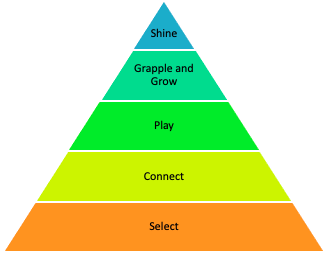
The Cycle of Excellence is a framework Dr. Edward Hallowell developed to recognize the potential in employees and foster high performance in various organizations. The program consists of five steps, which include the following (Harrison, 2011):
- Select: This step describes the selection of employees for a specific task;
- Connect: Determine how well the employee’s skill set fits into the organization;
- Play: Stands for imaginative engagement with one’s duties;
- Grapple and Grow: Overcoming difficulty and adversity to grow;
- Shine: Recognition by managers for excellent performance.
This framework is simple and easy to understand for managers to build their own subsystems. It also covers most points necessary for maintaining an effective team or a hiring process. It also has a few disadvantages, such as the ubiquity of excellent rhetoric, the lack of clarity in acceptable performance, and the absence of intermediate steps, such as a lack of engagement during the Play stage. Nevertheless, for human resources management, it is a good springboard to rely on. The following section will demonstrate how it can create one’s cycle of excellence.
Developing a Cycle of Excellence for Managing Human Capital
Human capital at any company is one of its greatest assets, as these individuals perform the work that makes a business thrive or fail. Therefore, when hiring someone, a system must be in place to ensure their skills are utilized to their maximum potential. In line with the Cycle of Excellence framework, the selection process is where it all starts.
For this proposed cycle, the HR must analyze the skills necessary for a specific task and align them with the candidate’s offer. The traditional layout puts the selection phase before the connection, but this approach has been criticized. If a company does not know what skills it needs in employees, then the connection part will fail to align with company goals (Armstrong & Taylor, 2020). Therefore, selection and connection need to be conjoined together. After the employee has been selected based on the skills needed, the rest of their abilities can be assessed in conjunction.
Equity, diversity, and inclusion are essential for the second half. People from different racial, ethnic, religious, and gender backgrounds can bring innovative and unique perspectives to the company. Therefore, with all other parameters equal, diverse candidates should be prioritized (Armstrong & Taylor, 2020). The play stage is when the enthusiasm of an employee is being gauged.
The introduction and training procedures are to be optimized to facilitate that engagement and prepare the prospective worker for future work, growth, and stress testing. Some selection processes should also be conducted at this stage – some individuals may have all the necessary qualifications while suffering from burnout from a previous job and industry(Rosenzweig et al., 2019). Should the incentives not work for some employees to rejuvenate their spirit and improve performance, they should be let go.
The stress testing is to be done during the grapple and throw stages, where new employees are challenged by tasks that will, on purpose, slightly exceed their performance capacity. This process is to be controlled not to overwhelm fresh candidates but to observe for performance increases and drops closely. Promotions and rewards could be good motivators for individuals to go above and beyond and embark on a journey of self-improvement. Life-long learning is a philosophy to be instilled on the company scale (Selimi, 2022). Finally, during the Shine stage, those who have performed the best will be awarded for their efforts.
However, the remaining individuals who have not succeeded should not be neglected or reprimanded. Excellence is a complex parameter to achieve by design, and without any aid in improvement, employees could become disheartened into mediocrity. The company should help them grow by offering feedback and repeating the play–stress–test–shine part again to work out the potential that might have been missed during the first cycle. Individuals who do not, over some time, display a capacity for growth may need to be replaced to ensure competitive advantage.
Discussing the Proposed Cycle
The proposed cycle is efficient for managing human capital for several vital reasons. First, it is based on a widely-recognized framework for managing employees (Harrison, 2011). Second, it addresses the issues of diversity and recognizes the importance of equity and inclusion of various points of view, personalities, skill sets, and backgrounds for maintaining a balance in the workforce and decision-making (Armstrong & Taylor, 2020).
It offers a transparent system of improvement and encouragement for individuals of talent and zeal and a road towards promotions. At the same time, it provides ways of motivating the entire employee workforce. Finally, the cycle recognizes that businesses can survive and thrive by acquiring the people best suited for their jobs (Selimi, 2022). As such, mechanisms of detecting and finding suitable people for suitable positions are necessary. The system can be applied to various situations within an HR environment.
References
Armstrong, M., & Taylor, S. (2020). Armstrong’s handbook of human resource management practice. Kogan Page Publishers.
Harrison, J. (2011). Interview with Edward M. Hallowell, MD, author of Shine: Using brain science to get the best from your people. Human Resource Management International Digest, 19(4), 43-45.
Rosenzweig, E., Queenan, C., & Kelley, K. (2019). Virtuous cycles of service quality: An empirical test. International Journal of Operations & Production Management, 39(2), 357-380.
Selimi, T. J. (2022). A Path to Excellence: The Blueprint to Achieving Your Greatest Potential. Tony Jeton Selimi.