
Introduction
The modern business environment is rapidly changing, which necessitates the need to adapt and enhance various system components within organizations. This is vital as the optimization of the business and various processes was supposed to improve security and speed up the decision-making process. Providing opportunities for employee self-management and strategic personnel decisions can be achieved through an improved Human Resource Information System (HRIS) that meets all the organization’s goals.
An essential aspect of selecting the right HRIS is a comprehensive analysis and comparison of systems to identify the most effective and efficient ones. Thus, by evaluating their capabilities and compatibility with existing data collection programs in companies, all the problems and strengths of the systems can be identified.
HR Information Systems
The current HR Data Collection system implemented in the company comprises several main elements, each of which must be manually updated when an employee is hired or fired. Thus, this significantly complicates the personnel management process and makes it more resource-intensive, distracting HR specialists from other vital tasks (Sedyastuti et al., 2021). Moreover, in the current system, all personnel records are maintained in paper format, which complicates their search and renders the filing process unautomatable. Demographic data is stored in Excel, but a manual approach is also used to complete it. Based on this, the current system is outdated and does not meet all modern business standards.
Cloud-Based HRIS System
A potential alternative that can be implemented in a company to facilitate employee work and automate their duties is the Cloud-Based HRIS System. The cloud solution has several significant advantages over the current one. It provides quick access to all the data, regardless of the number of HR personnel who need it (Hmoud & Várallyai, 2020). Paper archives are complex because multiple employees cannot view the document simultaneously to expedite work (Imron et al., 2019).
However, moving to the cloud can solve this problem, as all computers will have immediate access to personnel information. The encrypted storage of a digital platform can also provide sufficient security to limit the risks of data theft or illegal movement. Employees will be able to quickly request the necessary statistics, personal information, or receipts directly from the system, which will significantly reduce the burden on the bureaucracy.
On-Premises HRIS System
The second alternative to the company’s outdated current system is the On-Premises HRIS System. This method means that all employee data of the organization will be stored within the company on specially dedicated servers (Nakkeeran et al., 2021). This, in turn, personifies the first drawback of this method of managing the personnel department. The creation of a server room will require the allocation of a specific space and the purchase of expensive equipment that must be organized within the server room.
This method in this context is more similar to what is currently operating in the organization, with the difference that the new system, with the implementation of servers, will make access to data more convenient and automated (Jatav et al., 2022). In addition, this option has several advantages, the main one being that since these companies will not be sent to third-party cloud servers, their data will be stored more securely. However, this will also require an increased workload on the IT department to develop the appropriate software.
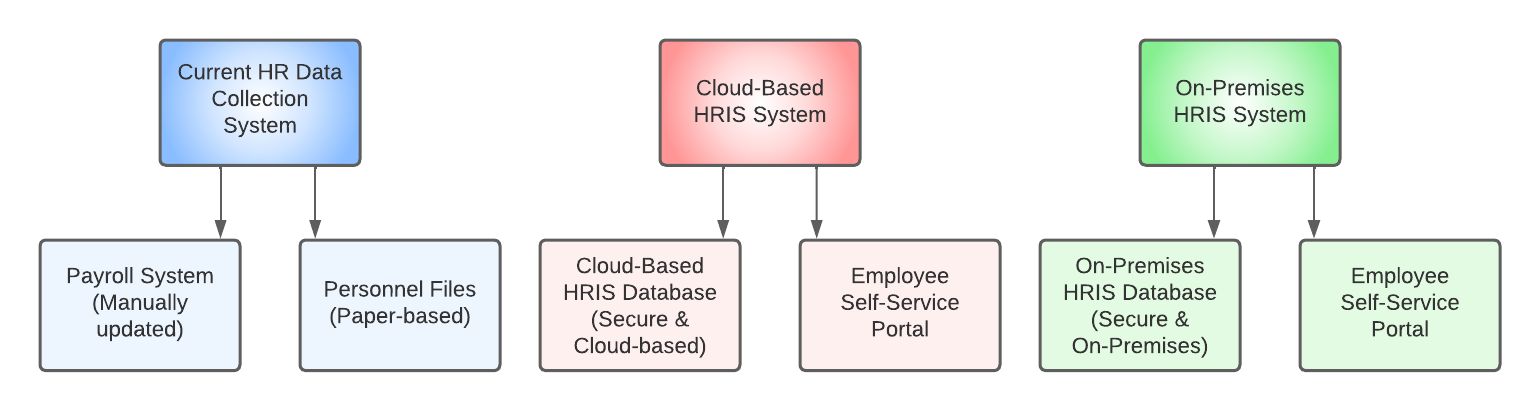
The two alternatives provided should not be considered and compared in isolation from the current Organizational Data Collection Systems. Human resources management and information collection are interrelated processes that should be studied in a complex manner and analyzed to determine the extent to which the interaction and cooperation of different systems can affect efficiency (Sedyastuti et al., 2021). A comparative analysis of the system components can be visualized using the Visual Map for each option in Figure 1. Thus, the systems differ slightly, with the central aspect being the type of data storage and how employees can access their personal files.
Gap Assessment
Assessment of Current Systems
Gap assessment is a critical factor that determines how a company should proceed to implement a new HRIS system. The gap assessment process should include some essential points, the first of which is an assessment of the current state of information systems. This category encompasses vital parameters such as software and systems. These factors are significant for the full and proper operation of personnel management systems (Boon et al., 2019). The operating system must be checked for compatibility with all programs and utilities that may be required to implement the new system. For a cloud-based HRIS, finding the right provider and verifying system compatibility are also necessary steps.
Hardware Upgrade
The second important point is the hardware upgrade, which is especially relevant for the On-Premises HRIS solution. This option requires a separate server room, which must be reliably protected from outside interference from both software and hardware (Boon et al., 2019). The reliability of purchased servers and their security are vital aspects that should be evaluated when choosing a new system. Cloud-based HRIS also requires testing of the hardware to see if it can unlock all the possible features of the new HRIS.
Optimizing the Selected System
The third step involves monitoring the performance and optimizing the selected HR system. Research into the performance and efficiency results obtained should be conducted to enable the company to have a clear understanding of which option can provide the most versatile features while being more user-friendly (Sedyastuti et al., 2021). The same aspect should include the calculation of the funding program to understand which of the considered systems may pose potential difficulties in this category. An informed decision should be made based on factors that indicate the most beneficial program for the company. However, it is essential to consider that staff comfort is a vital component of corporate performance.
Testing and Evaluation
A comfortable environment for employees can be achieved by the next step, which involves comprehensive testing and verification of the selected structure. This allows one to more clearly understand how, after all the checks, weaknesses can appear and whether they have been sufficiently addressed.
Thus, a pre-implementation check of HR information systems is essential to ensure a high level of interoperability with existing data collection systems (Sedyastuti et al., 2021). In addition, making informed decisions in this situation is essential to implement a plan to change the company’s personnel management system. As the report indicates, the primary drawback of the current system is its obsolescence, which must be taken into account when implementing the new strategy.
Conclusion
HR Information Systems are an integral part of any organization that has a large number of employees. The organization and management of the workforce are imperative aspects that must be carried out in accordance with all standards and norms of the working code. Additionally, the personnel department maintains a large number of documents that contain employees’ personal information. In this regard, the security aspect when choosing an information system should be one of the leading indicators. Thus, after a thorough analysis, it is possible to determine which system is the most suitable for the organization.
References
Boon, C., Den Hartog, D. N., & Lepak, D. P. (2019). A systematic review of human resource management systems and their measurement. Journal of management, 45(6), 2498-2537.
Hmoud, B. I., & Várallyai, L. (2020). Artificial intelligence in human resources information systems: Investigating its trust and adoption determinants. International Journal of Engineering and Management Sciences, 5(1), 749-765.
Imron, M. I. R., Hidayanto, A. N., Fitriani, W. R., Nugroho, W. S., & Inan, D. I. (2019). Analysis of cloud-based human resource information system adoption factors prioritization in micro, small, and medium enterprises. In 2019 International Conference on Advanced Computer Science and information Systems (ICACSIS) (pp. 295-300). IEEE.
Jatav, P. K., Nagar, N., Singh, A., & Sharma, Y. (2022). Comparative study of various tools of On-Premises ERP and Cloud based ERP. International Journal of Food and Nutritional Sciences, 11(11), 2038-2052.
Nakkeeran, A., Niranga, M., & Wickramarachchi, R. (2021). A Model for On-Premises ERP System and Cloud ERP Integration.
Sedyastuti, K., Suwarni, E., Rahadi, D. R., & Handayani, M. A. (2021). Human Resources Competency at Micro, Small and Medium Enterprises in Palembang Songket Industry. In 2nd Annual Conference on Social Science and Humanities (ANCOSH 2020) (pp. 248-251). Atlantis Press.