Introduction
Human resource management (HRM) plays a significant role in ensuring that employees are well-managed while also being treated fairly and equally. The disparity of treatment in the workforce can contribute to reduced job satisfaction and productivity while promoting turnover. Perceived unfairness can rise in the workplace when employees feel their salaries are insufficient and that some colleagues are favored over others.
HR professionals can introduce practices and activities that aim to promote fairness and equality in the workplace. Employees who feel that they are treated fairly are more likely to be engaged with their work responsibilities. Organizations should implement ethical policies and human resource development (HRD) programs to eliminate perceptions of workplace unfairness. Organizational leaders should also consider open communication in various work aspects to eliminate perceived unfairness. Fairness in the workplace can be achieved by promoting ethical policies and guidelines for conduct.
The Importance of HRM
HRM plays a significant role within an organization by ensuring that employees are managed appropriately. HRM is aligned with organizational goals while also promoting competitive advantage (Rees & Smith, 2017). HR professionals propose practices and activities that must be followed by all individuals within an organization (Armstrong, 2020). This provides an opportunity for them to introduce practices that uphold the fairness and equality of all people. Professionals can promote an inclusive organizational culture and values, ensuring that everyone is treated equally. HRM also exposes organizational members to developmental opportunities, enabling them to improve their skills and knowledge to perform their jobs effectively.
Disparity of treatment in the workplace can contribute to reduced job satisfaction. Perceiving unfair treatment can demotivate employees and lead them to lose commitment to their work. This, in turn, can lead to reduced productivity, as employees are not focused on achieving their desired goals. Unfair treatment can also play a significant role in increasing workforce turnover. Employees who feel they are mistreated may choose to look for an organization where they will be satisfied with their treatment.
The difference in treatment is not always inevitable, as it can occur intentionally or unintentionally, depending on the factors that influence it. In this case, some managers treat some of the employees well, knowingly. Disparity in treatment is not always a bad thing, as it can have positive effects on the workforce. Differences in treatment may be necessary for an HR manager who is faced with a workforce comprising employees with varying skills and qualifications. Such employees might require different levels of support or accommodations to meet their job objectives.
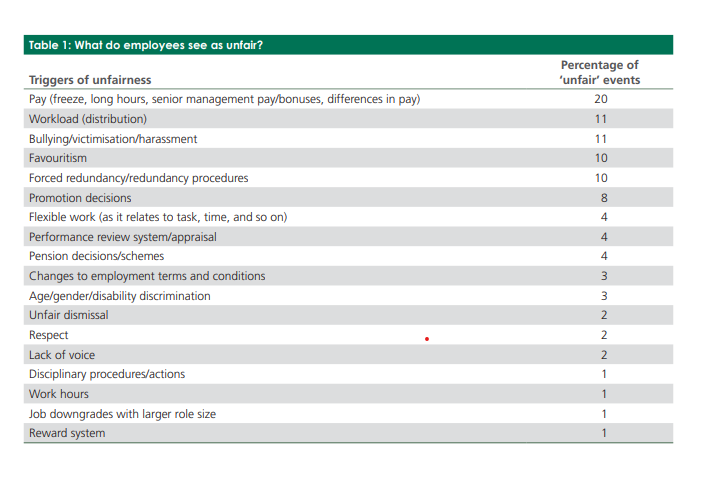
The CIPD human resource management report outlines ways human resource managers within an organization can promote fairness. The report examines the issue of workplace fairness and its evolving nature, enabling HR professionals to gain a deeper understanding of what employees perceive as fair treatment (CIPD, 2013). Such an understanding is necessary for them to introduce policies and practices that are likely to appeal to all employees. This is more likely to contribute to higher levels of employee satisfaction and engagement with their work. The report indicates that HR professionals can rely on various principles associated with distributive, procedural, and interactional justice to promote perceived fairness in the workplace. Properly applying the ideas presented in the CIPD report can enable HR professionals to enhance perceived fairness.
Triggers of Perceived Unfairness
Employee pay is one of the key triggers of perceived workplace unfairness. Employees are likely to perceive unfair treatment when they are paid less than their colleagues performing similar work activities. This can lead employees to believe they are being treated unfairly and that their input is not valued. Such a perception can contribute to a decline in morale and motivation. Perceived unfairness in remuneration can also increase when workers feel their pay is not commensurate with their contributions (Grosch & Rau, 2020). Such a perception can lead people to believe their employer does not value them and is using them for personal gain.
Employees can also develop a sense of unfairness when they consider that their pay is based on factors beyond their control. This can occur when workers do not understand how their salaries are determined (Köchling & Wehner, 2020). Perceptions about personal relationships and favoritism in the remuneration process can easily be considered as perceived bias. Organizations should develop payment processes that minimize the likelihood of perceived unfairness in their workforce.
Favoritism in the workplace can also contribute to employees’ perceptions of unfairness. Favoritism occurs when senior organizational members treat some employees more favorably than their colleagues (Arasli et al., 2019). Employees are likely to feel a sense of unfairness when some of their colleagues are given priority in making important decisions, such as promotions to senior positions. Favoritism can also arise when some employees are not held accountable for poor workplace performance because of their relationships with organizational leaders. Employees who develop such a perception are likely to lose trust in their leaders and their actions.
Promotion decisions can also lead to a perception of unfairness in the workforce. This can easily occur when the promotion is carried out in a manner that workers consider to be lacking transparency (Newman et al., 2020). Employees are also likely to feel that promotions are carried out unfairly, based on the perception that decisions are made without regard to qualifications and workplace performance (Dover et al., 2020). Such a feeling can contribute to reduced morale and motivation to address job responsibilities. A lack of feedback on why individuals were not considered for promotion can also lead to a perception of biased treatment among a section of employees. Openness in the promotion process can help minimize the likelihood that employees feel they are being mistreated.
Ethical Policies
Ethical workplace policies can help eliminate perceived unfairness within the workforce when properly implemented. Ethical policies provide a framework that seeks to ensure that all workers are treated equally. This is achieved by establishing clear guidelines for behavior and decision-making (Villegas et al., 2019).
The policies focus on eliminating discrimination, favoritism, and other practices that may lead to perceived unfairness in the workforce. Ethical policies can also play a significant role in building trust within the workforce that an organization is committed to upholding fairness and integrity. Being committed to preventing unethical behavior and promoting transparency can make employees feel valued and respected (Tiamboonprasert & Charoensukmongkol, 2020).
Effective and ethical policies can also contribute to a positive workplace culture that discourages unethical practices. This is necessary for employees to feel motivated and engaged with their work. Human resource professionals should promote ethical policies within their organizations to ensure that people do not act in ways that are likely to be perceived as unfair.
Negative and Positive Impacts on Disparity
Perceived unfairness can have both positive and negative impacts on workplace disparities. One negative impact of workplace unfairness is that employees are likely to become disengaged from their work. Individuals who are disengaged in their work are more likely to make errors that can contribute to expensive organizational expenses.
Low motivation also increases the likelihood that workers will leave an organization for one that promotes fair treatment. This can easily lead to workplace disparities, as the remaining employees are required to take on more duties and responsibilities than their job descriptions state. Perceived unfairness can also contribute to increased differences in the workplace by reducing employee motivation (Syed et al., 2021).
Unmotivated workers are unlikely to perform as expected, resulting in production disparities. Perceived unfairness can also contribute to differences in teamwork and workplace collaboration. Employees with such thoughts will likely have reduced trust in colleagues whom they perceive as being treated better.
A positive impact associated with perceived unfairness is increased awareness of workplace disparities. This can occur when employees express concerns about workplace unfairness. Such actions raise awareness among the leadership team, thereby increasing the likelihood of changes that prioritize fairness and equity.
Perceived unfairness can also exacerbate disparities by promoting increased advocacy in the workforce (Brouwers et al., 2020). Actions considered unfair can motivate employees to advocate for change by highlighting the workplace disparities they experience. In this case, employees are likely to raise concerns about workplace favoritism. This can help to raise awareness among HR professionals, which is necessary for changes to be implemented. Awareness of workplace biases is essential to implementing changes that foster a positive, inclusive environment.
Recommendations
One action an organization can take to reduce instances and perceptions of unfairness is to establish clear policies and guidelines addressing the issue. Policies and guidelines are essential for HR professionals and other leaders to understand how to treat each organizational member fairly (Nazir et al., 2019). The guidelines should focus on how employee payment and promotion decisions are determined.
Organizational leaders should also consider implementing Human Resource Development (HRD) programs to enhance their employees’ skills and abilities. Such opportunities make employees feel valued while providing them with opportunities for career progression (Werdhiastutie et al., 2020). Transparent communication can also play a significant role in eliminating aspects of perceived unfairness in the workforce. This might require employees to be kept up to date on changes and decisions that are likely to affect their work. Employees should also be allowed to ask questions about workplace issues. This is necessary to eliminate any misconceptions about instances of unfairness in the work environment.
Conclusion
In conclusion, HR professionals have a significant input in promoting fairness and equity within an organization. Failure to uphold fairness in organizational operations can lead employees to feel undervalued, which, in turn, reduces engagement and productivity. This can occur when employees perceive their pay as unfair and believe that their leaders engage in favoritism.
HR professionals should focus on establishing policies and practices that promote equality and inclusivity, rather than treating a subset of employees differently. Promoting fairness and ethical behavior in the workplace is necessary for employees to feel satisfied and remain engaged. It might also be necessary for organizations to consider introducing HRD programs to promote the career development of their members. Aspects of perceived unfairness in the workforce can also be mitigated through open communication, particularly when making important workplace decisions.
Reference List
Arasli, H., Arici, H.E., and Çakmakoğlu Arici, N. (2019). Workplace favoritism, psychological contract violation, and turnover intention: moderating roles of authentic leadership and job insecurity climate. German Journal of Human Resource Management, 33(3), pp.197-222.
Armstrong, M (2020). Armstrong’s Handbook of HRM Practice.
Brouwers, E.P.M., Joosen, M.C.W., Van Zelst, C. and Van Weeghel, J. (2020). To disclose or not to disclose: a multi-stakeholder focus group study on mental health issues in the work environment. Journal of Occupational Rehabilitation, 30, pp.84-92.
CIPD (2013). Can we match individual and organizational perspectives? The changing contours of fairness: in partnership with.
Dover, T.L., Kaiser, C.R., and Major, B. (2020). Mixed signals: the unintended effects of diversity initiatives. Social Issues and Policy Review, 14(1), pp.152-181.
Grosch, K. and Rau, H.A. (2020). Procedural unfair wage differentials and their effects on unethical behavior. Economic Inquiry, 58(4), pp.1689-1706.
Köchling, A. and Wehner, M.C. (2020). Discriminated by an algorithm: a systematic review of discrimination and fairness by algorithmic decision-making in the context of HR recruitment and HR development. Business Research, 13(3), pp.795-848.
Nazir, S., Shafi, A., Atif, M.M., Qun, W., and Abdullah, S.M.(2019). How organization justice and perceived organizational support facilitate employees’ innovative behavior at work. Employee Relations: The International Journal.
Newman, D.T., Fast, N.J. and Harmon, D.J. (2020). When eliminating bias isn’t fair: algorithmic reductionism and procedural justice in human resource decisions. Organizational Behavior and Human Decision Processes, 160, pp.149-167.
Rees, G., and Smith, P.E. (2017). Strategic human resource management: an international perspective. Strategic Human Resource Management, pp.1-616.
Syed, F., Naseer, S. and Bouckenooghe, D. (2021). Unfairness in stressful job environments: the contingent effects of perceived organizational injustice on the relationships between job stress and employee behaviors. The Journal of General Psychology, 148(2), pp.168-191.
Tiamboonprasert, W. and Charoensukmongkol, P. (2020). Effect of ethical leadership on workplace cyberbullying exposure and organizational commitment. The Journal of Behavioral Science, 15(3), pp.85-100.
Villegas, S., Lloyd, R.A., Tritt, A. and Vengrouskie, E.F. (2019). Human resources as ethical gatekeepers: hiring ethics and employee selection. Journal of Leadership, Accountability, and Ethics, 16(2), pp.80-88.
Werdhiastutie, A., Suhariadi, F. and Partiwi, S.G. (2020). Achievement motivation as antecedents of quality improvement of organizational human resources. Budapest International Research and Critics Institute-Journal (BIRCI-Journal) Volume, 3, pp.747-752.
Appendix